

 +91-9711070340
 info@archidply.com
+91-9319777646
exports@archidply.com
info@archidply.com
+91-9319777646
exports@archidply.com


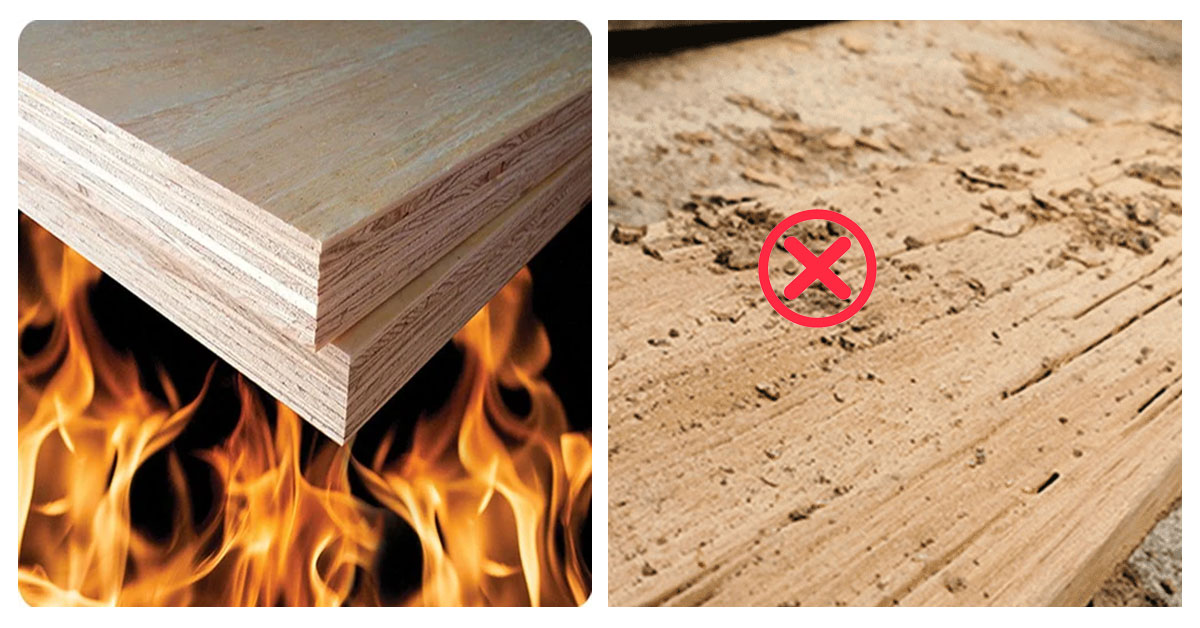
Most furniture doesn’t fail because it was badly designed. It fails because something got into it: termites working quietly behind a wardrobe, borers turning a shelf to powder, or, in the worst case, a fire that spread faster than anyone could react.
Two kinds of plywood are built to guard against those risks. Termite-resistant plywood is chemically treated so termites and borers cannot feed on it. Fire-retardant plywood is treated to resist ignition and slow the spread of flame, and in India it is tested to IS 5509. One protects the furniture from the inside out. The other protects the people around it.
India’s warm, humid climate is ideal for wood-destroying insects. Termites can enter a home through the ground and work their way through untreated wood without leaving much trace on the surface. Borers lay eggs in the timber itself, and the damage often shows only as fine powder and small holes years later.
By the time either is visible, the core of a wardrobe or bed is usually already hollow. Untreated plywood offers no defence. The protection has to be built into the sheet when it is made.
| Pest | How it reaches furniture | Typical signs |
| Subterranean termites | Travel up from the soil through walls, floors and cracks, often inside thin mud tubes | Mud tubes on walls, hollow-sounding panels, laminate that blisters or sinks |
| Drywood termites | Fly in and live entirely inside the wood, with no contact with soil | Small piles of hard, grain-like droppings below furniture |
| Wood borers | Beetles lay eggs in timber; larvae tunnel through it for months or years | Tiny round exit holes and fine, flour-like powder |
Termite and borer resistance comes from chemical treatment during manufacture. The treatment is carried through the veneers and the glue line, so the whole sheet, not just its face, is protected.
In Archidply’s BWP plywood, the core and face veneers are chemically impregnated and bonded using German glue line technology, which makes the sheet borer proof and resistant to termites. Because the treatment runs through the sheet, it stays in place even after the board is cut to size.
A word on “termite proof”. No treatment can stop termites from entering a building. Termite-resistant plywood means termites can’t feed on the sheet. For full protection, pair it with an anti-termite treatment of the building itself, and keep furniture away from damp walls.
Fire-retardant (FR) plywood is impregnated with fire-retardant chemicals during manufacture. When exposed to flame, the treated sheet resists catching fire, chars slowly and slows the spread of flame across its surface.
That matters most in the first minutes of a fire, when people are leaving the building. Fire-retardant plywood does not make a room fireproof. It buys time.
Wood burns in stages. Heat first drives off moisture, then breaks the wood down into flammable gases, and it is those gases that catch fire and feed the flame.
Fire-retardant chemicals interrupt that process. When the treated sheet heats up, they encourage the surface to form a layer of char quickly. That char layer insulates the wood underneath, slows the release of flammable gases, and makes it harder for flame to spread across or burn through the sheet.
The result is a panel that is slower to ignite, slower to burn through and slower to pass fire to the next surface.
| Basis | Regular plywood | Fire-retardant plywood |
| Treatment | No fire-retardant treatment | Impregnated with fire-retardant chemicals |
| Indian Standard | IS 303 or IS 710, by grade | IS 5509:2000 |
| Ignition | Ignites and spreads flame like untreated wood | Resists ignition and slows flame spread |
| Burn-through | No minimum time | Not less than 15 minutes per 6 mm of thickness |
| Best for | Homes and dry or wet zones, by grade | Commercial interiors, public buildings, kitchens, partitions |
| Cost | Lower | Higher, because of treatment and testing |
| Test | What it measures | IS 5509 requirement |
| Flame penetration | How long fire takes to burn through the sheet | Not less than 15 minutes for every 6 mm of thickness |
| Rate of burning | How long the sheet takes to lose 30% of its weight | Not less than 20 minutes |
| Flammability | How long before the sheet re-ignites a second time | Not less than 30 minutes |
| Space | Termite-resistant | Fire-retardant | Why |
| Bedroom wardrobes and beds | Recommended | Optional | Long-life furniture in contact with walls and floors |
| Kitchen cabinets | Recommended | Recommended near the hob | Moisture attracts insects; heat and open flame nearby |
| Ground-floor and garden-facing rooms | Strongly recommended | Optional | Closest to soil, where termites enter |
| Hotels and restaurants | Recommended | Strongly recommended | Many people, high-traffic interiors, kitchens |
| Hospitals and schools | Recommended | Strongly recommended | People who may need help to evacuate |
| Malls, cinemas and offices | Recommended | Strongly recommended | High occupancy, long exit routes |
| Partitions, false ceilings and wall panelling | Recommended | Strongly recommended | Large surface areas that can carry flame |
| Electrical and server rooms | Optional | Strongly recommended | Higher ignition risk |
What is fire retardant plywood? Fire-retardant plywood is treated with fire-retardant chemicals during manufacture so it resists ignition and slows the spread of flame. In India, it is tested to IS 5509:2000.
Is fire retardant plywood fireproof? No. It resists ignition and slows the spread of fire, which gives people more time to leave a building. Under enough heat and time, any wood-based panel will eventually burn.
Is termite proof plywood really termite proof? Treated plywood stops termites and borers from feeding on the sheet. It does not stop termites from entering the building, so pair it with an anti-termite treatment of the structure.
Where should fire retardant plywood be used? In hotels, hospitals, schools, malls, offices, cinemas and restaurants, and in homes for kitchen cabinets near the hob, partitions and wall panelling.
Can fire retardant plywood be laminated? Yes. It can be finished with laminates and veneers like other plywood. For the highest protection, pair it with a fire-retardant laminate such as Archidlam Fire Retardant Laminate.
Does fire retardant plywood cost more than regular plywood? Yes. The chemical treatment, extra processing and IS 5509 testing add to the cost. In commercial interiors, it is usually a small share of the total fit-out cost.
Is fire retardant plywood also waterproof? Fire retardancy and water resistance are separate properties. Check the sheet’s grade and standard for water resistance, and ask the manufacturer before using fire-retardant plywood in a wet zone.
How do I know if my furniture has termites? Look for mud lines on walls, hollow-sounding panels, bubbling laminate, fine powder or tiny holes. If you see any of these, call a pest-control professional.
Can termites eat treated plywood? Plywood that is chemically treated during manufacture is built to stop termites and borers from feeding on it. Pair it with building-level anti-termite treatment for complete protection.
The best protection is the kind you never have to think about again. Choose a sheet that is treated and tested for the risks your space actually faces, and it will quietly do its job for decades. That is what Archidply has been building since 1976. Download E-Brochure


