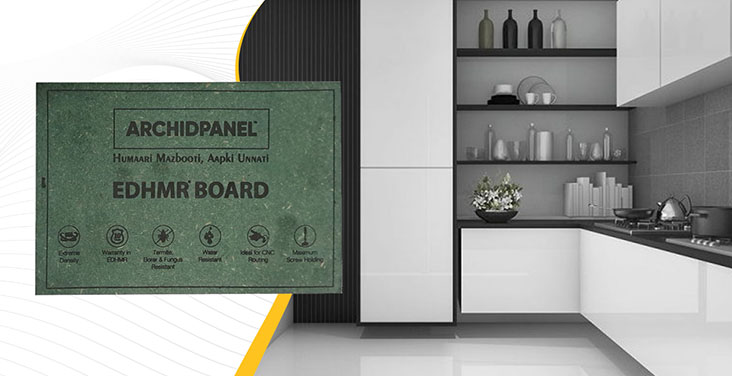
Modular furniture lives or dies on the board behind the laminate. HDHMR — High-Density High Moisture Resistant board — has become the standard choice for shutters, wardrobe doors and CNC-profiled panels, precisely because it holds its shape, its screws and its finish better than plywood’s grain or MDF’s softness allow. Archidply manufactures its version of this panel as Archidpanel EDHMR, engineered for the density, strength and moisture resistance that Indian interiors — and Indian humidity — actually demand.
What Is HDHMR Board, and Where Does Archidpanel EDHMR Fit In?
HDHMR, HDMR and EDHMR all describe the same category of engineered panel — a homogeneous, resin-bonded fibreboard, built by compressing wood fibres with melamine-fortified resin under high pressure. Unlike plywood, it has no layered grain to chip along when routed, grooved or CNC-profiled, which is why it has become the default for shutter fronts with a detailed or profiled design. Archidpanel EDHMR is Archidply’s own extra-dense variant within this category — built to a higher density than a standard HDHMR sheet, for the projects where that extra margin matters.
Built for Strength and Moisture — the Numbers Behind It
Archidpanel EDHMR is manufactured to a density of 850–900 kg/m³, with a minimum modulus of rupture of 32–35 N/mm² — the measure of how much bending stress the board resists before it fails. Water absorption is held to just 5% after two hours of soaking, and linear expansion in humid conditions is kept to a minimum, which is what actually protects a shutter or a cut-out from swelling out of shape through a monsoon season. Screw-withdrawal strength holds up under frequent opening and closing, which matters more on a drawer front over ten years than any single spec sheet number does on its own.
Termite, Borer and Fungus Resistant by Design
Because Archidpanel EDHMR is a homogeneous resin-bonded panel rather than a layered wood veneer, it doesn’t offer termites and borers the same entry points that raw or poorly sealed wood grain can — and it’s manufactured to resist fungal growth in humid, enclosed spaces such as kitchen and wardrobe carcasses. Cut edges should still be sealed or banded on-site, since an unsealed edge is the one place moisture can work into any engineered panel, this one included.
Where It’s Used
- Modular kitchen cabinets and shutters
- Wardrobe doors and drawer fronts
- Bathroom vanities and wet-area cabinetry
- Wall panelling and CNC-routed decorative panels
It isn’t a substitute for BWP-grade plywood in zones with standing or direct water — directly under a sink, or on an exposed exterior wall — where a boiling-water-tested plywood grade is still the right specification. For everything else, where finish, machining and moisture resistance matter more than raw structural load, it’s the board most architects reach for first.
A Range of Finishes, Manufactured Responsibly
Archidpanel EDHMR is available pre-laminated in a range of textures — wood grains, matte, suede and fabric finishes among them — so the shutter or panel is finish-ready without a separate lamination step. Manufacturing is compliant with low-formaldehyde emission norms, in line with Archidply’s broader commitment to eco-conscious production across its panel range.
A shutter, a wardrobe door or a kitchen panel only looks good for as long as the board underneath holds its shape. Archidpanel EDHMR is built for that — engineered density, tested moisture resistance, and a finish-ready surface, for interiors that need to survive daily use and Indian humidity in equal measure.
Notes for your team (not for publication)
- Density, water absorption, MOR and screw-withdrawal figures are pulled from Archidply’s own published Archidpanel EDHMR blog, so they’re used here with confidence rather than flagged — worth a quick QC glance to confirm they’re still current.
- Termite/borer/fungus resistance is stated as Archidply’s own existing published claim; if there’s a formal certification behind it, naming it would strengthen this section further.
- Pricing and exact thickness range aren’t included in this draft — add if you want them in the final version.


 +91-9711070340
 info@archidply.com


 Download E-Brochure


