

 +91-9711070340
 info@archidply.com
+91-9319777646
exports@archidply.com
info@archidply.com
+91-9319777646
exports@archidply.com


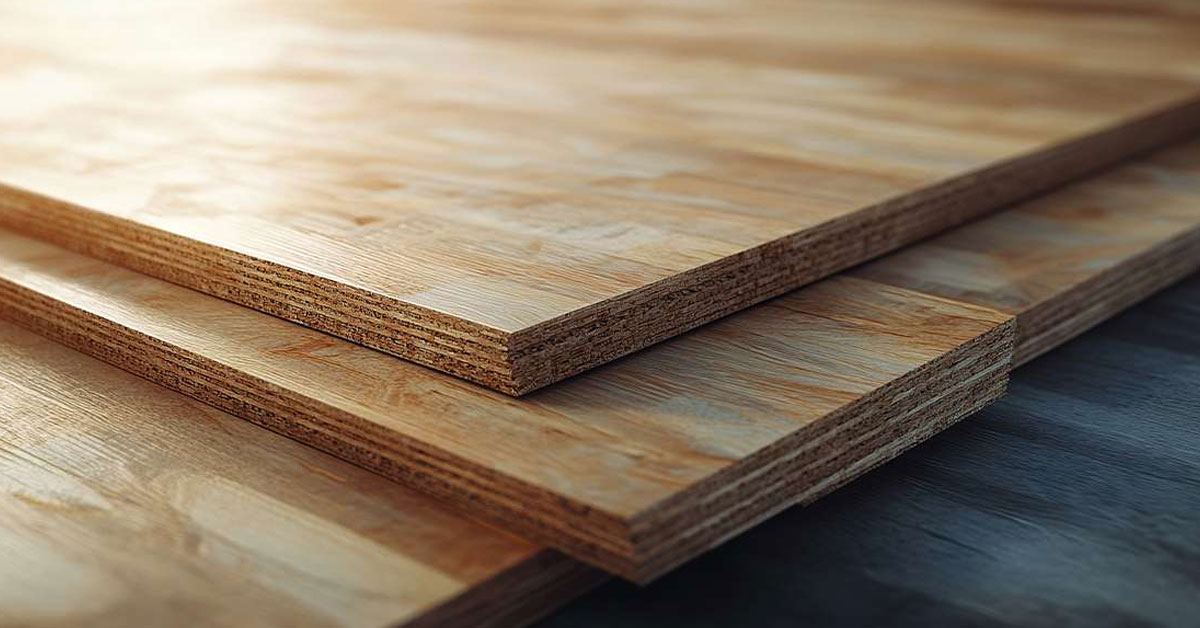
Walk into any plywood counter in India and “commercial” is the first word you will hear. It is also the most loosely used. Some dealers mean a grade, some mean a price band, and some simply mean “not the waterproof one.”
Here is the short answer. Commercial plywood is the trade name for MR (Moisture Resistant) grade plywood, made to IS 303 and bonded with formaldehyde-based resin, for dry interior furniture. It is the workhorse behind most wardrobes, beds, TV units and office desks in Indian homes. Choosing it well has less to do with finding the cheapest sheet and more to do with knowing what goes into one.
Plywood is made by bonding thin layers of wood veneer, with the grain of each layer turned at right angles to the one before. That cross-layering is what gives a sheet its strength and stops it from splitting along the grain.
What makes plywood “commercial” is the adhesive and the grade. Most commercial plywood uses urea-formaldehyde (UF) resin, which bonds well and keeps costs sensible, but is not designed for water. Archidply’s MR plywood is bonded with melamine formaldehyde resin instead. That makes it MR grade under IS 303, the Indian Standard for general-purpose plywood. It tolerates normal indoor humidity. It is not built for splashes, leaks or standing water.
That is not a weakness. It is a specification. A sheet built for a bedroom wardrobe does not need the resin system of a sheet built for a kitchen sink, and paying for one where the other will do is money that could have gone into better hardware or a better finish.
| Sheet size (ft) | Area per sheet (sq ft) |
| 8 × 4 | 32 |
| 8 × 3 | 24 |
| 7 × 4 | 28 |
| 7 × 3 | 21 |
| 6 × 4 | 24 |
| 6 × 3 | 18 |
| Thickness | Common uses |
| 4–6 mm | Back panels, drawer bottoms, curved surfaces |
| 9 mm | Drawer sides, light partitions, wall panelling |
| 12 mm | Short shelves, drawer boxes, internal dividers |
| 16 mm | Shelves and carcasses in light-duty furniture |
| 18–19 mm | Wardrobe and cabinet carcasses, shutters, beds, TV units |
| 25 mm | Table tops, heavy-duty shelves, long spans |
| Grade | Indian Standard | Bonding | Built for | Typical use |
| MR (commercial) | IS 303 | Urea- or melamine-formaldehyde resin | Dry interiors with normal humidity | Wardrobes, beds, TV units, study and office furniture |
| BWR | IS 303 | Phenol-formaldehyde resin | Humidity and occasional splash | Kitchen cabinets away from the sink, utility storage |
| BWP / Marine | IS 710 | Phenol-formaldehyde resin | Repeated or direct water contact | Under-sink units, bathroom vanities, exterior-facing work |
| Fire retardant | IS 5509 | Chemically treated for fire | Spaces where slowing fire spread matters | Malls, hospitals, hotels, partitions, kitchens |
| Factor | What changes the price | What to check before you buy |
| 1. Core timber | Dense hardwood cores cost more than lighter, mixed-species cores, and hold screws far better | Ask what timber the core is made from |
| 2. Thickness and calibration | Calibrated sheets are sanded to an even thickness across the whole board, which takes extra machining | Measure the thickness at all four corners |
| 3. Core construction | Machine-composed cores have fewer gaps and overlaps than hand-laid ones | Look at the cut edge for gaps, overlaps or filler |
| 4. Resin and treatment | Better resin and anti-termite, anti-borer treatment add cost per sheet | Ask what treatment the sheet has received |
| 5. Emission class | Low-formaldehyde sheets (E1, E0) need better resin systems and controls | Look for the emission class on the sheet or certificate |
| 6. Certification | A BIS licence under IS 303 means regular, independent testing | Check for the ISI mark and the licence number |
| 7. Warranty | A long written warranty reflects the maker’s confidence in the sheet | Ask for the warranty in writing, not as a verbal promise |
Archidply has been making plywood since 1976. Our MR-grade range, including Archidply MR Plywood Classic and Archidply MR Grade Plywood Classic, is made at our own facilities in Rudrapur and Sitarganj and is licensed by BIS under IS 303.
Archidply MR Grade Plywood Classic is made from high-quality hardwood, with core and faces bonded with melamine formaldehyde resin. It is borer and termite free, conforms to IS 303 and carries a 7-year warranty. It comes in 6, 9, 12, 15 and 18 mm, in sheet sizes from 6 × 3 ft to 8 × 4 ft, and is used for bank, hospital and commercial furniture.
Archidply MR Plywood Classic is also made from hardwood, borer and termite free, and available in 19 and 25 mm for partitions, racks, shelves and shutters.
A few things go into every sheet. Auto-composed core machines reduce gaps in the core veneer and remove manual assembly. Calibration sanding gives every board an even thickness. And in 2008, Archidply brought low-formaldehyde-emission plywood to the Indian market, long before most buyers were asking about it. Our full list of BIS licences, FSC certification and green-building approvals is on the certifications page.
Explore the complete Archidply plywood range, or talk to our team to find a dealer near you.Is commercial plywood waterproof? No. Commercial plywood is MR grade, which handles normal indoor humidity but is not designed for splashes or standing water. For wet zones, use BWR or BWP grade plywood.
What is the difference between commercial plywood and marine plywood? Commercial plywood is MR grade under IS 303 and is bonded with urea- or melamine-formaldehyde resin. Marine plywood is made to IS 710 with phenol-formaldehyde resin and is built to withstand repeated water contact. Marine plywood costs more and belongs in wet areas; commercial plywood belongs in dry ones.
Can I use commercial plywood in a kitchen? Only in dry parts of it, such as tall storage units away from the sink. The sink unit and the area around the hob should use BWP plywood, and the rest of the base cabinets are best in BWR.
What thickness of commercial plywood is used for wardrobes? Wardrobe carcasses and shutters are usually made in 18–19 mm plywood, with thinner sheets of 6–9 mm used for back panels. Your carpenter or designer will confirm based on the design and load.
How is commercial plywood priced in India? It is quoted either per sheet or per square foot. An 8 × 4 ft sheet is 32 sq ft. Price depends mainly on core timber, thickness, calibration, resin, emission class, certification and warranty.
What is the difference between commercial plywood and block board? Commercial plywood is made entirely from thin veneer layers. Block board has a core of solid wood strips between veneers, which makes it lighter and less likely to sag over long spans such as long shelves and tall wardrobe doors. Plywood generally holds screws better at its edges.
Can commercial plywood be used for beds? Yes. Beds sit in dry bedrooms, so MR-grade commercial plywood in 18–19 mm is a common and sensible choice for the frame, headboard and storage boxes.
Is commercial plywood treated against termites? It depends on the manufacturer. Archidply’s MR plywood is borer and termite free. Ask whether the sheet is chemically treated against termites and borers during manufacture, and check that the warranty covers it.
How long does commercial plywood last? In a dry room, a well-made sheet that is properly finished and installed can last for many years. The warranty is a good guide to the manufacturer’s own expectation.
Commercial plywood is not the budget option. It is the right option for the dry rooms of a home, as long as the sheet is built properly. Specify the grade, check what’s inside, and the furniture will outlast the trends it was built for. Since 1976, that has been the Archidply way. Download E-Brochure


