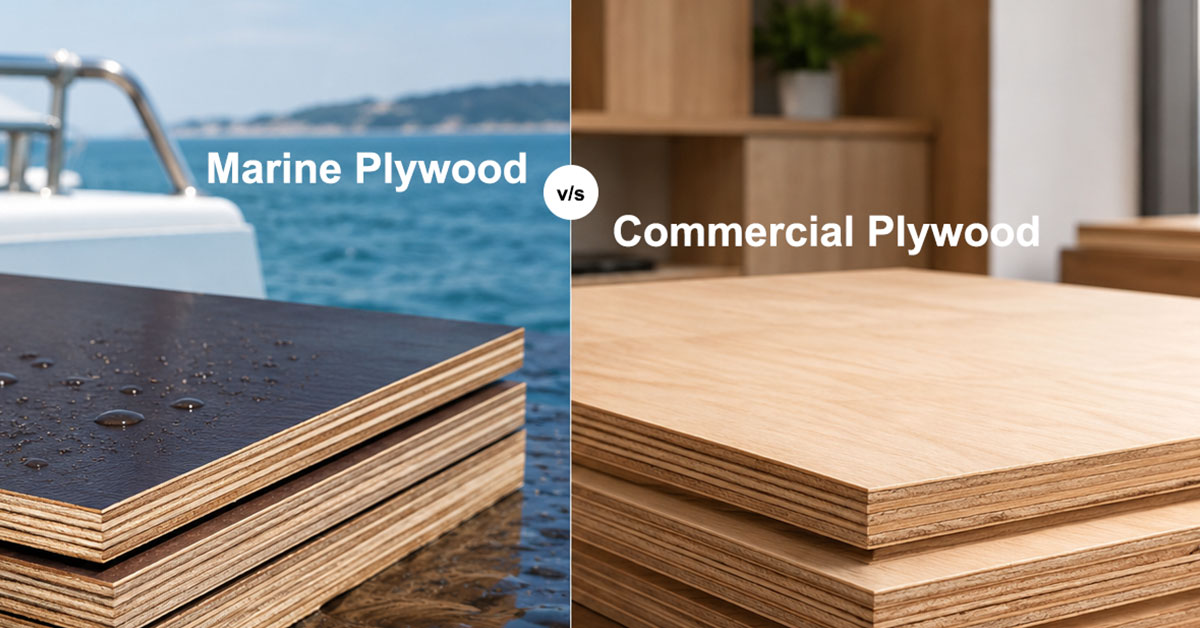
Ask a carpenter which plywood to use
and the answer is often one of two words: marine or commercial. One is
described as the safe choice, the other as the sensible one. Both descriptions
are half right.
Here is the short answer. Marine
plywood is made to IS 710, bonded with phenol-formaldehyde resin and built for
repeated contact with water. Commercial plywood is MR (Moisture Resistant)
grade under IS 303, built for dry interiors with normal humidity. Marine
plywood belongs where water is a regular visitor. Commercial plywood belongs
everywhere else. Most homes need both.
What Is Marine Plywood?
Marine plywood gets its name from boat building, where a sheet has
to stay intact in constant contact with water. In India, it is made to IS 710,
the Indian Standard for marine plywood.
Three things set it apart:
•
The resin. Marine plywood is bonded with phenol-formaldehyde (PF) resin. Once
cured under heat and pressure, PF resin forms a bond that does not soften in
water.
•
The timber. Marine-grade sheets are made from dense hardwood, with tighter
rules on defects and gaps in the core veneers.
•
The testing. IS 710 requires the sheet to survive 72 hours of continuous
immersion in boiling water without the layers separating. Marine plywood is
also treated against fungus, termites and borers.
That combination is why marine plywood is used under kitchen sinks,
in bathroom vanities and anywhere a sheet will get wet again and again.
What Is Commercial
Plywood?
Commercial plywood is the everyday trade name for MR (Moisture
Resistant) grade plywood, made to IS 303, the Indian Standard for
general-purpose plywood.
It is bonded with a formaldehyde-based resin designed for dry
conditions. Most commercial plywood uses urea-formaldehyde resin; Archidply's
MR plywood uses melamine formaldehyde resin. It handles the normal humidity of
an Indian home well. It is not designed for splashes, leaks or standing water.
That makes commercial plywood the right choice for bedroom
wardrobes, beds, TV units, study tables and office furniture: the furniture
that makes up most of a home. You can see every grade side by side in the Archidply
plywood range.
Marine
Plywood vs Commercial Plywood: Side-by-Side
|
Basis |
Commercial
plywood (MR) |
Marine
plywood |
|
Indian Standard |
IS 303 (general purpose) |
IS 710 (marine) |
|
Resin |
Urea- or melamine-formaldehyde |
Phenol-formaldehyde |
|
Timber |
Hardwood or mixed species, depending on the maker |
Dense hardwood, with stricter defect rules |
|
Water resistance |
Normal indoor humidity |
Repeated or direct contact with water |
|
Boiling-water test |
Not tested to a boiling-water standard |
72 hours of continuous boiling without delamination |
|
Treatment |
Depends on the maker; Archidply's MR range is borer and termite
free |
Treated against fungus, termites and borers |
|
Strength and density |
Good for furniture |
Higher density and screw-holding |
|
Relative cost |
Lower |
Higher |
|
Best for |
Wardrobes, beds, TV units, study and office furniture |
Sink units, bathroom vanities, hob area, balconies,
exterior-facing work |
|
Archidply options |
Why the
Glue Matters More Than the Name
The single biggest difference between the two is the glue line, not
the wood.
Urea-formaldehyde and melamine-formaldehyde resins form a strong
bond in dry conditions. Keep that bond wet for days, though, and it starts to
weaken. The layers begin to lift at the edges, the sheet swells, and laminate
starts to peel.
Phenol-formaldehyde resin is different. Once cured, it forms a bond
that stays intact even when soaked. It is also why the edge of a marine sheet
often shows a darker glue line than a commercial one.
This is why a commercial sheet that is perfectly happy inside a
bedroom wardrobe can fail within a few monsoons under a leaking sink, while a
marine sheet in the same spot can last decades.
Where You
Actually Need Marine Plywood
Marine plywood earns its higher price in places where water is not
occasional but expected.
•
The kitchen sink unit. Daily splashes, dripping utensils and the risk of a slow plumbing
leak make this the single most important place for marine plywood.
•
Base cabinets around the
hob. Steam, spills and cleaning water all reach
these units.
•
Bathroom vanities. Direct, daily water contact and high humidity.
•
Utility and laundry areas. Especially near the washing machine outlet.
•
Balconies and
exterior-facing furniture. Rain, monsoon moisture
and seepage through external walls.
•
Ground-floor rooms with
rising damp. Base units and anything touching the
floor or an external wall.
Where
Commercial Plywood Is the Smarter Choice
Using marine plywood everywhere is not wrong. It is just rarely
necessary. In dry rooms, commercial plywood performs very well and leaves room
in the budget for better hardware, better laminates or better finishes.
•
Bedroom wardrobes and lofts
•
Beds and storage boxes
•
TV units and display units
•
Study tables and bookshelves
•
Office workstations, cabinets
and storage
•
Wall panelling and partitions
in dry rooms
A Room-by-Room Guide
|
Room
or zone |
Recommended
plywood |
Why |
|
Kitchen sink unit |
Marine |
Daily water and possible leaks |
|
Kitchen base units near the hob |
Marine |
Steam, spills and cleaning water |
|
Kitchen base units away from water |
BWR or marine |
Humidity and occasional spills |
|
Kitchen wall units and tall units |
BWR, or MR in dry climates |
Steam and humidity, little direct water |
|
Bathroom vanity |
Marine |
Direct, daily water contact |
|
Bedroom wardrobe |
Commercial (MR) |
Dry, normal humidity |
|
Bed and storage boxes |
Commercial (MR) |
Dry, normal humidity |
|
TV and display units |
Commercial (MR) |
Dry, normal humidity |
|
Study and home office |
Commercial (MR) |
Dry, normal humidity |
|
Balcony furniture |
Marine, with exterior-grade finish |
Rain and monsoon moisture |
|
Wardrobes in coastal cities |
BWR or marine |
Year-round high humidity |
There is a middle grade worth knowing about. BWR (Boiling Water
Resistant) plywood sits between the two, handling humidity and occasional
splashes well at a lower cost than marine. It is a sensible choice for kitchen
units away from the sink and for wardrobes in humid cities. Our guide to waterproof plywood
grades explains where each
fits.
The Real Cost Difference
Marine plywood costs more per sheet than commercial plywood, and the
reasons are real: denser timber, a resin system built for water, more thorough
treatment and stricter testing.
But the sheet price is only part of the cost of a kitchen or
bathroom. Labour, hardware, laminate, countertops and fitting usually cost more
than the plywood itself. If a sink unit made from the wrong grade swells, all
of that has to be redone.
A practical way to think about it:
1.
Count the wet zones. In a typical home, the sink unit, hob base units, vanities and
utility units are a small share of the total sheets used.
2.
Use marine there. The extra cost applies only to those sheets.
3.
Use commercial or BWR for
the rest. The dry rooms make up most of the order,
and they don't need marine.
The result is protection where it matters and a sensible total
budget.
Common Myths
•
"Marine plywood is
waterproof, so it can't fail." Marine plywood
resists water far better than other grades, but a raw, unsealed edge can still
let water into the core over time. Seal every edge.
•
"Commercial plywood is
low quality." It is a grade, not a quality
level. A well-made, certified MR sheet is the right choice for dry rooms.
•
"Marine is always
better." In a dry bedroom, marine plywood
gives you no practical advantage over a good MR sheet, only a higher bill.
•
"All marine plywood is
the same." Check for the ISI mark, IS 710 and
the BIS licence number. A sheet sold as "marine" without them may not
meet the standard.
How to Check Before
You Buy
1.
Read the stamp. Look for the ISI mark, the Indian Standard (IS 710 for marine, IS
303 for MR) and the BIS licence number.
2.
Look at the edge. Core layers should meet cleanly, without gaps or filler. Marine
sheets typically show a darker glue line.
3.
Ask for the grade on the
invoice. "Marine, IS 710" or "MR, IS
303", not just "waterproof" or "commercial".
4.
Get the warranty in writing. Marine sheets usually carry longer warranties.
5.
Check the emission class. Low-emission sheets (E1 or E0) matter in bedrooms and closed
kitchens.
Installation Tips for
Both
•
Seal every cut edge with edge banding, inside and outside the cabinet.
•
Laminate both faces. A balancing laminate on the inside keeps the sheet flat.
•
Keep base units off the
floor on legs or a plinth.
•
Leave an air gap between furniture and external or wet walls.
•
Fix leaks immediately. Even marine plywood lasts longest when water doesn't sit against
it.
Marine
and Commercial Plywood From Archidply
Archidply has been making plywood since 1976 and holds BIS licences
for both IS 710 and IS 303.
•
Gold Marine
is BWP-grade marine plywood made to IS 710 from 100% hardwood timber, bonded
with phenol-formaldehyde resin using German glue line technology. It is
calibrated, borer and termite free, rated E-0 for formaldehyde emission and
carries a 30-year warranty. Available in 6, 9, 12, 16 and 19 mm.
•
Platinum Prime
is a marine-grade IS 710 sheet with a thicker face veneer, E-0 emission rating,
fungus and termite resistance and a lifetime warranty. Available in 4, 6, 9,
12, 16 and 19 mm.
•
MR Grade Plywood Classic is made from
high-quality hardwood bonded with melamine formaldehyde resin. It is borer and
termite free, conforms to IS 303 and carries a 7-year warranty. Available in 6,
9, 12, 15 and 18 mm.
Every sheet is made at Archidply's own facilities in Rudrapur and
Sitarganj, with auto-composed core machines and calibration sanding for
consistent thickness. Explore the full plywood
range,
see our certifications,
or find
a dealer near you.
Frequently Asked
Questions
What is the difference between marine plywood and commercial
plywood? Marine plywood is made to IS 710 with
phenol-formaldehyde resin and dense hardwood, and is built for repeated contact
with water. Commercial plywood is MR grade under IS 303, bonded with urea- or
melamine-formaldehyde resin, and built for dry interiors.
Is marine plywood better than commercial plywood? For wet areas, yes. For dry rooms like bedrooms and living rooms, a
good commercial (MR) sheet performs just as well at a lower cost.
Can I use commercial plywood in the kitchen? Only in the dry parts, such as tall storage units away from the
sink. Use marine plywood for the sink unit and around the hob.
Is marine plywood fully waterproof?
Marine plywood is built to withstand repeated water contact and passes a
72-hour boiling-water test under IS 710. Raw cut edges should still be sealed
to keep water out of the core.
Why is marine plywood more expensive? It
uses denser hardwood, phenol-formaldehyde resin, more thorough treatment
against fungus and insects, and stricter testing to IS 710.
Should I use marine plywood for my whole house? It isn't necessary. Use marine plywood in wet zones and commercial
or BWR plywood in dry rooms to balance protection and budget.
What is BWP plywood, and is it the same as marine? BWP stands for Boiling Water Proof. Archidply's BWP plywood, Gold
Marine, is made to IS 710, the marine standard, so the two terms are often used
together.
How long does marine plywood last?
Properly installed and finished, marine plywood is built for decades.
Archidply's Gold Marine carries a 30-year warranty and Platinum Prime a
lifetime warranty.
Which thickness should I use for kitchen cabinets? Carcasses and shutters are usually made in 18–19 mm, with thinner
sheets of 6–9 mm used for back panels.
Marine and commercial plywood are not rivals. They are partners in a
well-built home, each doing the job it was made for. Match the sheet to the
water each space will see, and every room will hold up the way it should. That
has been the Archidply approach since 1976.