For decades, buyers asked two
questions about plywood: how strong is it, and how much does it cost? A third
question has now joined them, and it is being asked more often every year:
where did the wood come from?
Here is the short answer. FSC-certified
plywood is made from timber that can be traced, through a certified chain of
custody, back to forests or plantations managed to the standards of the Forest
Stewardship Council. It tells you the wood was sourced responsibly. It
doesn't replace ISI certification, which tells you the sheet performs. The best
plywood carries both.
What Is FSC?
The Forest Stewardship Council (FSC) is an international, non-profit
organisation founded in 1993. It sets standards for how forests should be
managed, covering environmental protection, the rights of workers and local
communities, and the long-term health of the forest itself.
FSC
doesn't certify forests or factories directly. Independent, accredited
certification bodies audit them against FSC standards. That independence is
what gives the label its weight: the claim is checked by people who don't sell
the product.
The Two Types of
FSC Certificate
FSC certification works in two parts, and a plywood sheet needs both
to carry an FSC claim.
|
Certificate |
Who
holds it |
What
it covers |
|
Forest Management (FM) |
Forest and plantation owners and managers |
That the forest or plantation is managed to FSC's environmental
and social standards |
|
Chain of Custody (CoC) |
Mills, manufacturers, traders and distributors |
That FSC-certified material is tracked and kept separate at every
step, from forest to finished product |
Think of Forest Management as proof of where the wood started, and
Chain of Custody as proof that the same wood actually reached the finished
sheet. If any company in the chain isn't certified, the claim stops there.
FSC Labels: 100%,
Mix and Recycled
You will see three main FSC labels on wood products.
•
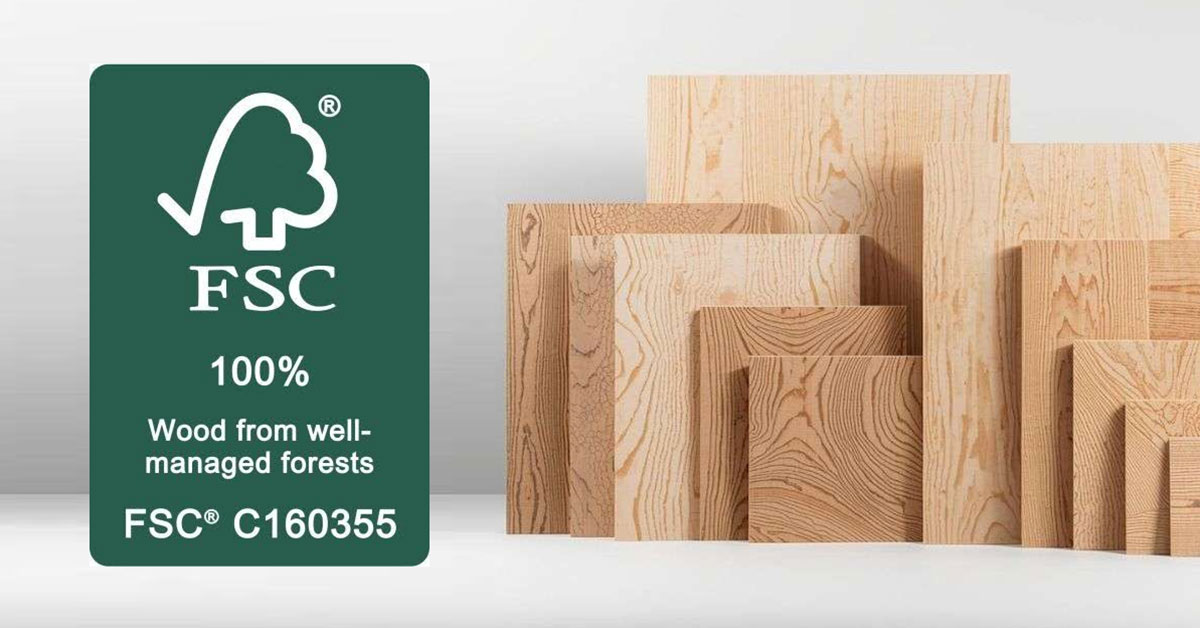
FSC 100% means all the material comes from FSC-certified forests.
•
FSC Mix means the product combines material from FSC-certified forests,
recycled material and controlled wood. Controlled wood is not from certified
forests, but is checked to exclude the highest-risk sources, such as illegally
harvested timber.
•
FSC Recycled means the product is made from reclaimed or recycled material.
For plywood, FSC Mix is common, because manufacturers draw timber
from several sources. All three are legitimate FSC claims. What matters is that
the claim is backed by a valid certificate.
Why
Sustainable Sourcing Matters Now
Forests are under pressure
Wood is one of
the few building materials that can be grown again. That is only true if it is
harvested responsibly. Unmanaged logging degrades forests, harms wildlife and
damages the communities that depend on them. Certification is the most widely
recognised way to show that wood was taken in a way the forest can recover
from.
India's plywood
depends on grown timber
A
large share of the timber used by India's plywood industry comes from
plantations and farm forestry, where trees are grown, harvested and replanted
on a cycle. Certification helps show that this cycle is being managed
responsibly, and that wood from unknown or high-risk sources is kept out.
Green buildings ask for it
Green building
rating systems used in India, such as IGBC and GRIHA, reward projects for using
responsibly sourced and low-emission materials. Certified wood can help a
project earn those credits. For architects designing to a green rating,
FSC-certified plywood is often the simplest way to document a material choice.
Corporate and
institutional buyers expect it
Many
companies now report on the environmental impact of their offices, hotels,
hospitals and campuses. Their procurement teams increasingly ask suppliers for
proof of responsible sourcing alongside quality certificates.
Export markets require proof
Buyers in
Europe, North America and elsewhere increasingly need evidence that the wood
products they import are legally and responsibly sourced. For manufacturers
that export, a recognised certification makes that evidence easier to provide.
Homeowners are asking
The question isn't
limited to large projects. More families now want to know that the materials in
their homes are safe to live with and responsibly made. Sustainable sourcing
and low formaldehyde emission often go together in that conversation.
FSC vs Other
Certifications
FSC is one part of a complete picture. Each certification answers a
different question.
|
Certification |
The
question it answers |
|
ISI mark (BIS) |
Does the sheet meet the Indian Standard for its grade? |
|
FSC |
Was the timber responsibly sourced and tracked through the supply
chain? |
|
E0 / E1 emission class |
How much formaldehyde does the sheet release into indoor air? |
|
GreenPro |
Does the product meet green product criteria across its life
cycle? |
|
GRIHA / IGBC |
Does the product support green building ratings? |
|
CARB / EPA |
Does the product meet international formaldehyde emission rules? |
|
ISO 14001 |
Does the manufacturer run a certified environmental management
system? |
A sheet that is FSC certified but not ISI certified tells you the
wood was sourced well, but not whether the sheet will perform. A sheet that is
ISI certified but uncertified for sourcing tells you the opposite. For a
responsible, long-lasting build, look for both.
How to Verify an FSC
Claim
FSC claims can be checked, and checking takes only a few minutes.
1.
Look for the FSC label and
licence code. Genuine FSC labels carry a licence
code that identifies the company using the label.
2.
Ask for the certificate
code. Chain of Custody certificate codes follow a
set format, often starting with the certification body's code followed by
"-COC-" and a number.
3.
Search FSC's public
certificate database. FSC publishes a searchable
database of every certificate holder. Check that the certificate is valid,
belongs to the company you are buying from, and covers the product type.
4.
Check the invoice. For a product to be sold as FSC certified, the FSC claim (such as
"FSC Mix") and the seller's certificate code should appear on the
sales invoice or delivery documents.
5.
Ask about the whole chain. If you buy through a dealer, the dealer may also need to be
certified for the claim to pass through to you. For green building
documentation, confirm this with your supplier.
Common Myths
•
"FSC means the wood
comes from a protected forest." No. It means
the forest or plantation is managed responsibly, and harvesting is planned so
the forest can renew.
•
"FSC plywood is
weaker." Certification covers sourcing, not
strength. Performance depends on the grade, the timber, the resin and the
manufacturing, which is why ISI certification still matters.
•
"Any eco-friendly claim
is the same as FSC." "Eco-friendly"
and "green" are not certifications. FSC is a specific, independently
audited standard.
•
"FSC is only for
exports." Domestic green buildings,
institutions and homeowners increasingly ask for it too.
Sustainability
Beyond the Label
Responsible sourcing is one part of what makes plywood sustainable.
A few other factors matter just as much.
•
Low formaldehyde emission. Sheets rated E1 or E0 release less formaldehyde into indoor air,
which matters in bedrooms, children's rooms and closed spaces.
•
Durability. A sheet that lasts thirty years instead of ten means fewer
replacements and less waste. The right grade in the right place is a
sustainability decision.
•
Efficient manufacturing. Accurate peeling, machine-composed cores and calibration sanding
reduce waste at the factory.
•
Certified management
systems. ISO 14001 certification shows a
manufacturer is managing its environmental impact systematically.
Archidply and
Responsible Sourcing
Archidply has been making plywood since 1976, and sustainability has
been part of its story for much of that time.
•
FSC certified. Archidply holds an FSC certificate, published on its certifications page.
•
Low emission, early. In 2008, Archidply introduced low-formaldehyde-emission plywood in
India and promoted it nationally. Its premium marine grades, Gold
Marine and Platinum
Prime, are
rated E-0, and Archidply holds an E-Zero certificate.
•
Green building approvals. GreenPro certification across plywood, block boards and flush
doors, plus GRIHA, IGBC membership and Ecomark.
•
International emission
standards. CARB and EPA certification.
•
Certified systems. ISO 9001 for quality management and ISO 14001 for environmental
management.
•
Built to last. Warranties of up to 30 years on Gold Marine and Fire Retardant
Plywood, and a lifetime warranty on Platinum Prime.
Architects and project consultants have long recommended Archidply
for green building projects. As one project management consultant puts it on
Archidply's website, "We suggest Archidply products as Eco friendly
products, which have been useful for Green building projects."
Explore the full Archidply
plywood range or talk to our team about
certification documents for your project.
Frequently Asked
Questions
What is FSC-certified plywood? It is
plywood made from timber that can be traced, through a certified chain of
custody, to forests or plantations managed to Forest Stewardship Council
standards.
What does FSC stand for? Forest
Stewardship Council, an international non-profit organisation founded in 1993
that sets standards for responsible forest management.
What is the difference between FSC 100% and FSC Mix? FSC 100% products use only material from FSC-certified forests. FSC
Mix products combine certified material with recycled material and controlled
wood, which is checked to exclude high-risk sources.
How can I check if plywood is really FSC certified? Ask for the certificate code and look it up in FSC's public
certificate database. The FSC claim and certificate code should also appear on
the invoice.
Is FSC-certified plywood more durable? FSC
certification covers sourcing, not strength. Durability depends on the grade
and manufacturing, so look for ISI certification as well.
Does FSC plywood help with green building ratings? Responsibly sourced, certified wood can help projects earn credits
under green building rating systems such as IGBC and GRIHA. Confirm the
requirements with your project's green building consultant.
Is FSC-certified plywood more expensive?
It can cost slightly more, because certification and tracking add cost. For
green projects and responsible buyers, the documentation is usually worth it.
Is Archidply plywood FSC certified?
Archidply holds an FSC certificate, published on its certifications page. Ask
your dealer or the Archidply team about FSC-certified supply for your project.
What else makes plywood eco-friendly?
Low formaldehyde emission (E1 or E0), long life, efficient manufacturing and
certified environmental management all contribute.
The most sustainable sheet of plywood is one made from responsibly
grown wood, built to last for decades and safe to live with every day.
Archidply has been working toward that standard since long before it became a
trend, and will keep doing so for the next fifty years.